30 Zaner-Bloser Handwriting Worksheets
Reviewed by: Ostap Yaromyr · 2026-11-11 · 13 min read
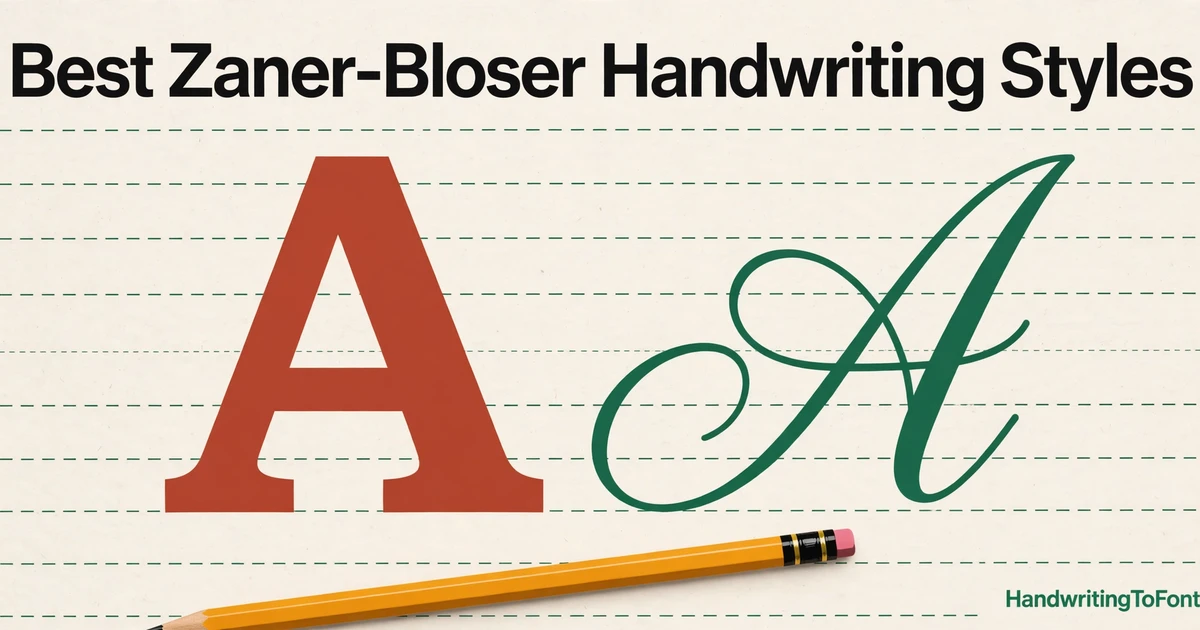
Zaner-Bloser is America's classroom handwriting institution, teaching manuscript and cursive to grades K to 6 for well over a century. These are the 30 Zaner-Bloser handwriting worksheets worth knowing: what each one teaches, which grade it belongs to, and where each kind honestly comes from.
The method began with Charles Paine Zaner's penmanship school in 1888 and the publishing house he built with Elmer Bloser; today Zaner-Bloser (part of the Highlights family) sells a full K–6 programme of student editions, workbooks, blackline masters and ruled paper. Its letterforms are the ones in the Wikipedia description of the teaching script: simple, vertical, built from a handful of strokes.
This guide organises the worksheet universe the way a teacher or homeschool parent actually meets it: manuscript foundations in kindergarten and grade 1, sentence work as manuscript matures, the cursive curriculum from grade 2's transition through grade 5, and the practice extras, contest sheets and comparisons that surround the programme.
The honesty note, up front: Zaner-Bloser worksheets are commercial, copyrighted materials. The genuine workbooks and blackline-master PDFs come from the publisher and its authorised sellers (the Zaner-Bloser store, Rainbow Resource, Christianbook, Amazon), not from free-download sites. Every worksheet below is described so you can find the real thing, or make an equivalent practice sheet in the same style with printable templates, without touching a pirated scan.
The Paper Every Worksheet Sits On
Zaner-Bloser's ruled paper is half the method. Three lines govern every letter, and the worksheets assume them, so learn the paper first and every page that follows makes sense.
Zaner-Bloser Ruled Paper: The Three Lines
Stroke School: The Four Strokes Behind Every Letter
Zaner-Bloser teaches strokes before letters. Master these four movements and both alphabets, manuscript and cursive, become assemblies rather than mysteries; the early worksheets below are mostly these strokes wearing disguises.
Undercurve
The swing under a letter: i, u, w, t and most cursive joins ride on it
Downcurve
The arc over the top: c, a, d, g and the round letters begin here
Push Up
The straight slanting climb: manuscript sticks and cursive stems
Overturn
Over and down: m, n, h and b turn on this hinge movement
Group 1: Manuscript Foundations, Kindergarten to Grade 1 (Worksheets 1–8)
The programme opens with manuscript: unjoined, vertical letters built from circles and sticks, sized to fill the space between baseline and headline. These worksheets overlap heavily with the first-school-days material in our kindergarten handwriting styles guide, with the Zaner-Bloser difference being discipline: strokes first, letters second, words third.
1. Manuscript Alphabet Trace, A to Z
The flagship sheet: all 26 capitals with dotted models, arrows and start dots. Zaner-Bloser capitals are deliberately plain: circles, verticals and horizontals a five-year-old's hand can actually produce, with no serifs, slants or surprises.
2. Lowercase Manuscript Trace
The harder alphabet: small letters sorted by the space they occupy, tall ones reaching the headline, small ones stopping at the midline, and the descenders (g, j, p, q, y) diving below the baseline in later sheets.
3. Numbers 1 to 10 (The ABC 123 Sheet)
Numerals taught as letterforms with the same stroke logic, matching the programme's early 'ABC 123' materials. Formation matters more than it looks: a badly built 5 in kindergarten becomes a decade of unreadable maths.
4. Name Writing Frame
A boxed frame with the three lines, sized for one job: the child's own name, traced then copied then written solo. Zaner-Bloser's writing frames recur across the early grades because the name is the first text any writer truly owns.
5. Basic Strokes Practice
Rows of undercurves, downcurves, push-ups and overturns before any letter appears. It looks like doodling and is actually the entire method in embryo; teachers who skip it spend October reteaching the letters built from it.
6. Letter Families by Stroke
Letters grouped by their starting stroke rather than alphabet order: the downcurve family (c, a, d, g, o, q), the undercurve family, the push-up family. One movement learned, five letters unlocked; this grouping is the method's quiet genius.
7. First Words and Sight-Word Copying
Short high-frequency words copied on the three lines, finger-space gaps marked. The worksheet where letters become reading: the words match early phonics readers, including the SuperKids reading programme Zaner-Bloser publishes for K–2.
8. My Story Journal Pages (Grade K)
Half drawing box, half three-line writing space: the journal format behind the 'My Story' materials. Children draw the story, then write its caption in manuscript, which teaches the deepest lesson early: handwriting exists to carry meaning.
Print practice sheets in the same spirit
For daily drill between workbook pages, ruled templates with the same three-line structure let you generate endless trace-and-copy practice at any size. Print a stack, keep them by the workbook, and no child ever waits for the next official page.
Get Handwriting TemplatesGroup 2: Manuscript Grows Up, Grades 1 to 2 (Worksheets 9–14)
Manuscript does not end at the alphabet. These sheets stretch it into sentences, spacing and self-checking, the unglamorous skills that decide whether a child's writing survives contact with real schoolwork.
9. Sentence Copying on Three Lines
Whole sentences copied with capitals at the headline and periods sitting on the baseline. The worksheet where sizing discipline is graded: a capital that floats or a small letter that touches the headline both get circled.
10. Spacing and Finger-Space Sheet
Copying tasks engineered around gaps: too tight, too wide, just right. Zaner-Bloser treats spacing as a taught skill with its own practice pages, because cramped words undo good letters faster than any bad stroke.
11. Size-Reduction Worksheet
The same letters written at shrinking line heights as grade 2 approaches: the programme gradually narrows the paper's line spacing, training the hand to stay formed when the training wheels come off. Small, dull, absolutely decisive.
12. Paragraph Copying and Indenting
Multi-line passages with an indent to copy, margins to respect and a title to centre. This is manuscript's graduation exercise before cursive arrives, and the page teachers photograph for bulletin boards.
13. Self-Check Rubric Sheet
The programme's evaluation language as a worksheet: children score their own lines for size, shape, slant and spacing, then rewrite their worst word. Self-assessment pages like this are why the method's results survive after the workbook closes.
14. Friendly Letter Worksheet
A letter format page, greeting, body, closing, on three lines: manuscript applied to a real genre with a real audience. Many classes pair it with the programme's journal materials; the letter a child mails teaches more than ten drills.
Group 3: The Cursive Curriculum, Grades 2 to 5 (Worksheets 15–24)
Zaner-Bloser introduces cursive after manuscript is secure, traditionally across grade 2 into grade 3, and its cursive is famously Plain: slanted, looped, but free of the ornamental swashes of older American hands like Palmer. If your child is starting from zero, pair these sheets with a learn cursive routine so the joins arrive as a system, not a surprise.
15. Lowercase Cursive Alphabet
The transition alphabet: every small letter rebuilt around the undercurve join. Taught in stroke families again, letters that begin alike arriving together, so the hand learns five movements and inherits twenty-six letters.
16. Uppercase Cursive Alphabet
Capitals, deliberately simpler than historical scripts: Zaner-Bloser capitals avoid the stacked loops of Spencerian and Palmer, which is exactly why the method's cursive survives in real classrooms. The Q that looks like a 2 is the famous talking point.
17. Joining Pairs and Letter Connections
Two-letter drills for every join type: undercurve joins, downcurve joins, and the bridge joins after b, o, v and w that trip every beginner. Boring to watch, thrilling in week three when whole words suddenly flow.
18. Cursive Word Practice (Grade 3 Workbook Pages)
The grade 3 workbook's core pages: themed word lists copied, then written from dictation. This is the volume behind most 'grade 3' searches, the year cursive stops being a subject and starts being handwriting.
19. Cursive Sentence Copying
Sentences mixing every join, graded on rhythm as much as shape: even spacing between letters inside words, even slant down the page. The worksheet where cursive either becomes fluent or stays a costume.
20. Grade 4 Fluency Pages
Longer passages, smaller lines, timed copying goals off to the side. Grade 4 in the programme is about speed with form kept: the sheets introduce copying under gentle time pressure, the classroom's first handwriting-as-sport.
21. Grade 5 Cursive Workbook Pages
The grade 5 volume: cursive applied to reports, letters and note-taking, with style expectations (consistent slant, closed loops, legible capitals) assessed like a real skill. Behind the 'grade 5' searches is usually a parent rescuing a fading hand.
22. Signature Development Sheet
A page devoted to the one cursive text every adult needs: practise boxes for building a signature from the student's own name, with legibility rules (your name should still be readable; flourishes are seasoning, not the meal).
23. Manuscript-to-Cursive Transition Chart Sheet
Side-by-side alphabets, print form beside cursive form, letter by letter. Kept on desks and classroom walls, it is the Rosetta page of the whole programme, and the single most photocopied reference in the system.
24. Numerals and Punctuation in Cursive Context
Dates, addresses, numbered lists and quoted sentences: the supporting cast of real writing, practised explicitly instead of being left to chance. Unglamorous pages; adulthood is built from them.
The wider cursive family tree
Zaner-Bloser cursive is one answer to a century of American handwriting arguments. Our cursive styles guide walks the relatives: Palmer's business hand, Spencerian's elegance, D'Nealian's rival school script, and where the ZB hand sits among them.
Explore Cursive StylesThe Scope and Sequence Ladder, K to 6
Where each worksheet lives in the programme's official arc. 'Scope and sequence' is the phrase teachers search, and this ladder is the honest summary: manuscript first, cursive when manuscript is automatic, fluency after that.
Group 4: Practice Extras, Contests and Comparisons (Worksheets 25–30)
25. National Handwriting Contest Practice Sheet
Zaner-Bloser runs the National Handwriting Contest, the largest handwriting competition for schoolchildren, running since 1991. Its practice pages mimic the entry task: a set text copied in your best manuscript (K–2) or cursive (3 and up), judged on size, shape, slant and spacing, the rubric from worksheet 13 with stakes.
26. Blackline Masters (Reproducible Practice Pages)
The teacher-side treasure: blackline masters are the photocopiable master pages bundled with programme adoptions, extra drills, review sheets and assessment pages designed to be run off by the class set. Searches for them are really searches for legitimate bulk practice, which is why they live behind adoption, not on free sites.
27. Zaner-Bloser vs D'Nealian Dual-Practice Sheet
For families switching schools mid-stream: the same words written in both systems, ZB's vertical manuscript beside D'Nealian's slanted, tailed letters. The face-off panel below breaks the differences down; this sheet is where children physically feel them.
28. Zaner-Bloser Font Practice and Display Sheets
The programme's letterforms exist as licensed teacher fonts (the 'ZB font' searches), used to make classroom worksheets that match the taught hand exactly. Before buying any font, preview your worksheet words in a font viewer; a model alphabet that mismatches the workbook teaches two hands at once, badly.
29. Homeschool Daily Drill Pages
The homeschool pattern sold through sellers like Rainbow Resource: one workbook page a day, five days a week, roughly a school year per grade volume. The drill pages work because of the unglamorous arithmetic: fifteen focused minutes daily compounds like interest.
30. Your Own ZB-Style Practice Sheet
The endpoint: a blank three-line sheet and a hand that no longer needs the model line. Every programme, Zaner-Bloser included, is scaffolding; the building is a child (or an adult re-learner) writing legibly without thinking about it.
The Face-Off: Zaner-Bloser vs D'Nealian
America's other great school script is the comparison every parent eventually types. Both teach manuscript then cursive; they disagree about how letters should be built in the years between.
Zaner-Bloser
- Manuscript stands vertical, built from separate strokes
- Letters are lifted-and-placed: print first, joins added years later
- Cursive arrives as a distinct second alphabet (grades 2–3)
- Strength: early letters are simple for small hands to form
D'Nealian
- Manuscript slants, with tails and continuous strokes
- Letters are drawn in one motion, pre-shaped for joining
- Cursive grows out of manuscript with fewer relearned forms
- Strength: the manuscript-to-cursive transition is gentler
Neither system wins in the research by a knockout; children thrive under whichever is taught consistently. School-scheme loyalty is not only American, either: Britain argues the same argument over its own schemes, as our Nelson handwriting styles guide shows.
The Worksheet Picker: Start Where You Are
Starting kindergarten at home
Start with: strokes (5), alphabet trace (1–2), name frame (4). Fifteen minutes a day, and stop while it is still fun; the method's sequence rewards patience more than volume.
Rescuing a messy grade 2 hand
Start with: self-check rubric (13), spacing sheet (10), size reduction (11). Diagnose before drilling: most 'bad handwriting' at this age is spacing and sizing, not letterforms.
Cursive from zero, grade 3
Start with: transition chart (23) on the wall, lowercase alphabet (15), joining pairs (17). Words (18) only when joins survive two-letter drills without tears.
Making practice feel like play
Start with: contest sheet (25) for a goal, story journal (8) for meaning, and for pure delight, the decorated practice in our cute handwriting styles guide, where neat letters learn to smile. Skill first, sparkle second, both on the page.
Three Honest Buying Notes
Editions change; prices move. Zaner-Bloser sells per-grade student editions, workbooks and teacher materials through its own store and education sellers, and pricing varies by edition and format (print vs digital licences). Anyone quoting you one eternal price for 'the programme' is guessing; check the current grade volume at the publisher or Rainbow Resource.
The app and login are for adopters. The programme's digital materials and app access ride with school and district adoptions (hence the 'login' searches). Homeschool families usually get the full benefit from the print workbook alone; do not buy a licence tier you cannot log into.
Free is a warm-up, not the programme. Legitimate free Zaner-Bloser material exists as samples and contest resources from the publisher. Full 'free PDF' copies of current workbooks on random sites are pirated scans, poor quality, often incomplete, and unfair to a programme schools have trusted for a century. Sample pages plus a real workbook is the honest route.
When the workbook hand becomes their hand
Worksheets end; handwriting continues. If your child (or you) ends up with a hand worth keeping, capture it as a real font made from your own handwriting, free, and let the letters they practised type everything from labels to letters home.
Make Your Font FreeQuestions
Where can I get Zaner-Bloser handwriting PDFs?
Legitimately, from the publisher and its authorised sellers: the Zaner-Bloser store sells current grade workbooks and digital materials, and Rainbow Resource, Christianbook and Amazon carry the print editions. Full workbooks are commercial products, so complete 'free PDF' copies on random sites are pirated scans, usually incomplete and badly reproduced. Publishers do offer sample pages and contest materials free, which is the right way to preview before buying.
What grade does Zaner-Bloser handwriting cover?
Kindergarten through grade 6 (with contest categories beyond). Manuscript begins in kindergarten, is mastered across grades 1 and 2, and cursive is introduced around the grade 2 to 3 transition, then developed through grades 4, 5 and 6. Each grade has its own student edition or workbook, which is why searches are so grade-specific: the grade 1, 2, 3 and 5 volumes are genuinely different books.
What is the difference between Zaner-Bloser and D'Nealian?
Philosophy of the first strokes. Zaner-Bloser manuscript stands vertical and is built from separate, lifted strokes: print first, joins taught later as a distinct cursive alphabet. D'Nealian manuscript slants and gives letters tails and continuous strokes from the start, so cursive grows out of it with less relearning. Neither has a knockout research victory; consistency of teaching matters more than the system chosen.
Is there a Zaner-Bloser handwriting font?
Yes, the programme's letterforms are available as licensed fonts for teachers, in manuscript and cursive versions with ruled-line and dotted-trace variants, sold through font and education suppliers. They exist so classroom-made worksheets match the taught alphabet exactly. Check the licence before buying: classroom use is standard, while redistributing the font or selling materials made with it is usually not covered.
What is the Zaner-Bloser National Handwriting Contest?
An annual competition run by Zaner-Bloser since 1991 and billed as the largest handwriting contest for schoolchildren. Students copy a set text in manuscript (younger grades) or cursive (older grades), and entries are judged on the programme's own rubric: size, shape, slant and spacing. Schools enter through their teachers, and state and national winners are recognised each year. Practice sheets that mimic the entry task are worksheet 25 in this guide.
How much does Zaner-Bloser handwriting cost?
It depends on the grade, the format and the edition year, which is why this guide will not print a single price. Individual student workbooks are modestly priced paperbacks at education sellers like Rainbow Resource; full classroom adoptions with teacher editions, blackline masters and digital licences cost considerably more. Check the current edition of the exact grade volume you need at the publisher's store or a listed seller before budgeting.
What are Zaner-Bloser blackline masters?
Blackline masters are the photocopiable master pages included with programme adoptions: extra practice sheets, review pages, take-home drills and assessments designed to be reproduced for a whole class. They are the legitimate source of bulk Zaner-Bloser practice, and the reason teachers guard them. If you are a homeschooler wanting the same volume of practice, a workbook plus printable three-line templates covers most of it.
What is the Zaner-Bloser scope and sequence?
The programme's official teaching order. In summary: kindergarten covers strokes, manuscript letters and first words; grade 1 masters manuscript in sentences and journals; grade 2 builds fluency and introduces cursive late in the year; grade 3 is the full cursive year; grades 4 to 6 develop cursive speed, form and application to real schoolwork. The ladder in this guide maps worksheets 1 to 30 onto that sequence.
Is there a Zaner-Bloser handwriting app?
The programme includes digital components and app-based practice for adopting schools and districts, accessed through educator accounts, which is why 'login' and 'app' searches usually end at a sign-in page. For home users, the print workbook remains the complete product; if your child's school uses the programme, ask the teacher whether home app access is included with the class adoption.
What is the connection between Zaner-Bloser and SuperKids?
Same publisher. The SuperKids Reading Program is Zaner-Bloser's K to 2 reading curriculum, built around a cast of characters, and its early literacy work assumes the Zaner-Bloser handwriting sequence running alongside: letters being read are the same letters being written, in the same stroke order. Homeschool families often meet the two together in catalogues like Rainbow Resource, which sells both lines.