29 Best Nelson Handwriting Styles
Reviewed by: Ostap Yaromyr · 2026-11-10 · 12 min read
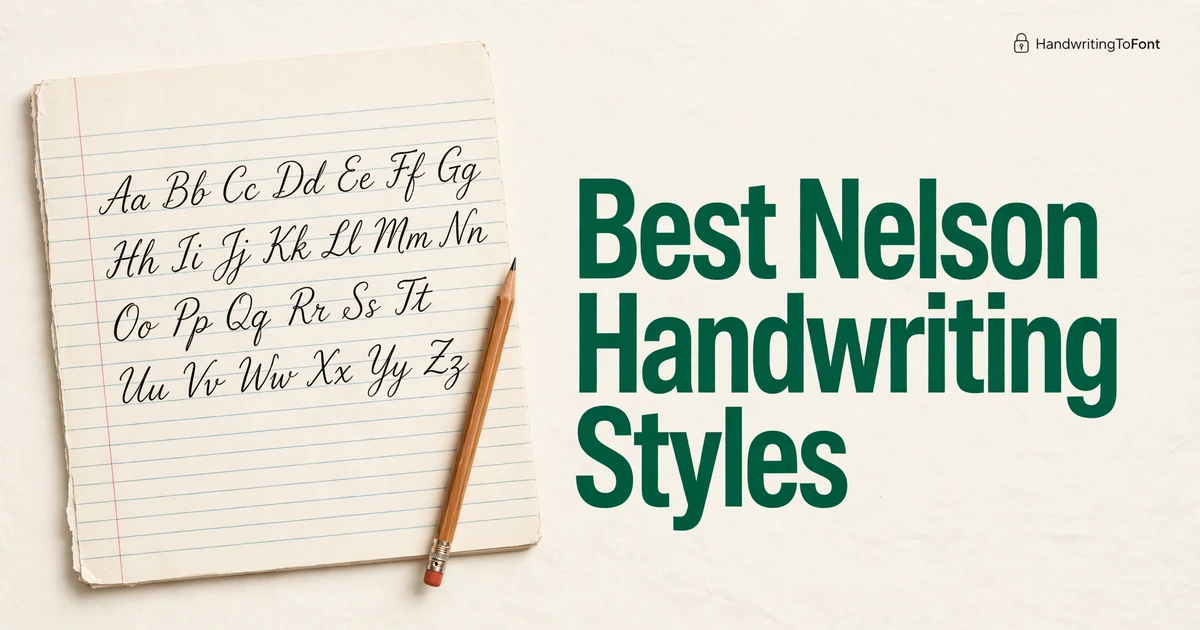
Nelson Handwriting is the scheme behind handwriting lessons in thousands of British primary schools: a complete journey from a Reception child's first patterns to a joined, fluent hand by Year 6, published by Oxford University Press.
This guide walks all 29 Nelson handwriting styles: the stages of the hand itself, the pupil books and workbooks level by level, the famous joins, the Nelson font, and the rival schemes parents and teachers compare it with. Each style comes with a specimen and an honest note on what it is for.
One honesty note before the tour: Nelson is a commercial school scheme, and its books are copyrighted. This page explains the styles and points to the legitimate routes, including the free Nelson resources Oxford itself provides. It does not hand out pirated PDFs, and you should be suspicious of any site that does.
Looking for a specific book or worksheet? The ladder below maps every level of the scheme first. Find your child's year, and the right style, book and expectations are all in one place.
The Nelson Ladder: The Whole Scheme at a Glance
Patterns and first letters. Pre-writing patterns, big arm movements, then print letters in families. Workbooks are called Starter A and Starter B, and play matters more than pages.
Print perfected. All 26 letters formed correctly and consistently, sitting on the line, with the exit flicks quietly added that cursive will later need.
The first joins. Diagonal joins appear, then joins to ascenders and horizontal joins, taught in the scheme's set order. Writing becomes genuinely joined for the first time.
Joined and reliable. KS2 consolidation: joins become automatic, letter sizes even out, and presentation across all schoolwork is the real curriculum.
Fluency and a personal hand. Speed, stamina and slope arrive, and the scheme deliberately loosens its grip so a legible personal style can emerge before secondary school.
The Nelson Alphabet Plate, A to Z
The reference every Nelson search is really after: the full alphabet in the scheme's spirit, print capitals and the pre-cursive lowercase with its lead-out flicks, the forms worksheets across the UK copy daily.
Nelson-Style Alphabet
a b c d e f g h i j k l m n o p q r s t u v w x y z
Specimens on this page are set in the closest matching typefaces. The scheme's own letterforms live in its books and its official font, covered at styles 17 and 18.
Group 1: The Stages of the Nelson Hand (Styles 1–8)
Before the books, the hand. Nelson is one long argument that handwriting should be taught in this order and no other, a philosophy our survey of different types of handwriting styles meets in several other school systems too.
1. Nelson Pattern Practice
Where the scheme truly begins: rows of waves, loops, zigzags and circles that build the movements letters are made of. Children who rush patterns rush letters, so Nelson spends real time here in Reception.
2. Nelson Print Letters
The manuscript stage: separate, upright letters formed with consistent starting points and exits, taught in movement families rather than alphabet order. Correct formation now is what makes joins possible later.
3. Nelson Pre-Cursive
Print letters grow lead-out flicks, the little exit strokes that reach toward the next letter. Nothing joins yet, but every letter already knows the way out. This in-between stage is the scheme's signature move.
4. The First Join (Diagonal)
The milestone Year 2 children remember: the diagonal join, sweeping up from the baseline to the top of the next letter, as in 'in', 'an' and 'on'. Nelson introduces this join first, and 'first join' becomes classroom vocabulary.
5. Joins to Ascenders
Next in the order: diagonal joins climbing to tall letters like t, l, h and b, where the joining stroke must travel further and land precisely. Taught as its own stage because the climb changes the rhythm of the word.
6. Horizontal Joins
The wave-like join that leaves the top of o, r, v and w and travels sideways into the next letter. It feels different in the hand from any diagonal join, which is exactly why the scheme teaches it separately and later.
7. Nelson Fully Joined Cursive
The destination of the early years: every join in place, words flowing in one movement, descenders looping under the line. From here the teaching shifts from formation to fluency, and our guide to the best cursive handwriting styles shows the wider family this hand belongs to.
8. The Fluent Sloped Hand
Upper KS2's quiet graduation: a slight slope is permitted, joins may simplify, and speed with legibility outranks identical letters. Nelson's model hand becomes a launchpad, deliberately, rather than a cage.
Practising Nelson letters at home?
School worksheets stay at school, but practice paper should not. Our printable handwriting template gives you the lined base for Nelson-style letters and joins, ready to print for tonight's ten minutes.
Get the Handwriting TemplateThe Join Map: Nelson's Order of Joins
Ask a Nelson teacher about the scheme and they will talk about joins before letters. This is the order the joins arrive, the sequence behind the search term 'nelson handwriting order of joins', mapped as four stations.
Station 1: Diagonal Joins
Baseline to the top of short letters. The first join, taught at the start of the joining stage, joining letters like i, a, u, m and n.
Station 2: Joins to Ascenders
The same diagonal, climbing higher to reach tall letters. The hand learns to aim, not just to travel.
Station 3: Horizontal Joins
A wave out of the top of o, r, v and w. The odd one out in the family, and deliberately taught after the diagonals feel automatic.
Station 4: Break Letters
Some letters end a join rather than pass one on: after letters like b, g, j, p, q, s, x and z the pen lifts and the next letter starts fresh. Knowing where NOT to join is half of joined writing.
Group 2: The Books, Level by Level (Styles 9–16)
Each level of the scheme has its own look, because each level has its own job. Here is what actually changes from book to book, including where the journey starts for the very youngest writers in our kindergarten handwriting styles guide.
9. Starter Workbook Style (Reception)
Starter A and B: oversized letters, patterns before print, and formation taught through rhymes, air writing and big movements. The workbooks assume a child who is still learning to hold a pencil, and they are right to.
10. Pupil Book 1 (Year 1)
Print letters mastered in their movement families, with sizing and line placement as the year's real targets. Pupil Book 1 is the volume behind most 'nelson handwriting pupil book 1 pdf' searches, usually from parents reinforcing school at home.
11. Pupil Book 2 (Year 2)
The joining book: diagonal joins, joins to ascenders, horizontal joins and break letters, in the map order above. By its final pages, most children write fully joined for the first time in their lives.
12. Pupil Book 3 (Year 3)
KS2 begins, and the ask changes from 'can you join' to 'can you join at the speed of thought'. Book 3 drills consistency: even sizes, even joins, tidy presentation across longer pieces of writing.
13. Pupil Book 4 (Year 4)
Stamina year. The hand must hold its quality across a full page, then two. Nelson introduces more writing at length, because Year 4 handwriting fails from tiredness far more often than from ignorance.
14. Pupil Book 5 (Year 5)
Slope, speed and personal letterforms enter openly. Book 5 treats the model as a default to depart from intelligently, and teachers begin judging writing the way readers do: by flow and clarity together.
15. Pupil Book 6 (Year 6)
The exit book: a mature, individual, reliably legible hand, ready for secondary school's volume and pace. The scheme's work is done when the writer no longer thinks about the scheme.
16. Copymasters and Worksheet Style
The photocopiable army behind the books: Nelson's copymasters and practice sheets carry the same letterforms onto endless drills, assessments and homework. Their consistent, unglamorous design is why 'nelson handwriting worksheets' is its own search genre.
Turn tonight's spellings into Nelson-style practice
Type any word list and see it in clear practice lettering, ready to print and copy. It will not replace the scheme's books, but for homework words and name practice it is exactly the right shape of help.
Try the Handwriting GeneratorGroup 3: The Nelson Font and Digital Styles (Styles 17–20)
17. The Nelson Handwriting Font
The scheme's official typeface, supplied with its software so teachers can make worksheets in the exact classroom letterforms: print, pre-cursive and joined variants included. Schools guard it because consistency between screen, sheet and book is the entire point.
18. The Jarman Font
The name that follows Nelson searches everywhere: Christopher Jarman's school handwriting font, long used in British classrooms and in materials alongside schemes like Nelson's. Its clear, joined letterforms made it the default 'school font' of a generation of worksheets.
19. Nelson on Oxford Owl
Oxford's home-learning platform carries Nelson support into kitchens: guidance for parents, printable help and explanations of the joins your child brings home. When school says 'we follow Nelson', Oxford Owl is the legitimate free window into what that means.
20. Nelson Software and Whiteboard Style
The scheme's digital editions put animated letter formation on the classroom whiteboard: watch the stroke, trace the stroke. For children who learn by watching, the moving letter teaches what a static worksheet cannot.
Group 4: Letterform Details Teachers Obsess Over (Styles 21–25)
21. Nelson's Letter Families
Letters are taught grouped by the movement that starts them, not alphabetically: families of letters sharing one opening stroke, learned together so the hand reuses a motion it already owns. Teach a family, and five letters arrive for the price of one idea.
22. Break Letter Behaviour
The scheme's most-tested detail: certain letters never pass a join onward, so the pen lifts after them. Children who join everything produce spectacular tangles after g and b; Nelson names the exceptions early and drills them as their own tiny style.
23. Nelson Capitals
Capitals stay unjoined, always: clear, separate, and formed to sit proudly at the head of a joined sentence. The contrast is the lesson: lowercase letters socialise, capitals stand alone, and mixing the rules is what makes writing look grown-up.
24. Nelson Numbers
Digits get the same formation care as letters, with the classic confusions, 2 and 5, 6 and 9, taught apart and anchored hard. In a scheme built for schools, number formation is numeracy's handwriting, and Nelson treats it that seriously.
25. Looped Descenders
The glamour strokes: g, y, j and f dive below the line and return with a loop that carries the join forward. Descenders are where joined writing either flows or drowns, and Nelson gives them dedicated practice rather than hoping they settle.
Group 5: Nelson Among Its Rivals (Styles 26–29)
No scheme is chosen in a vacuum. These last four styles are really comparisons, the ones staffrooms and parents actually weigh, ending where every good scheme intends to end.
26. Nelson vs Penpals for Handwriting
The heavyweight contest of UK primaries. Penpals (Cambridge) teaches in its own letter families with memorable characters and reaches joins on a similar timetable. Nelson's edge is its Oxford ecosystem and assessment materials; Penpals' is its playful family system. Schools rarely regret either.
27. Nelson vs Collins Handwriting
Collins offers a leaner, no-nonsense route with strong worksheet support, often at a friendlier price. Nelson answers with depth: more levels of copymasters, the font, the software, the training. The choice is usually ecosystem versus simplicity.
28. Nelson vs Magic Link and Berol
Different animals entirely: Magic Link is a focused cursive programme promising fast transformation of older children's writing, and Berol's materials served an earlier generation of classrooms. Nelson is the full primary journey, ages four to eleven, which is both its strength and its commitment.
29. The Hand Nelson Is Building: Yours
Every scheme on this page exists to be outgrown. Style 29 is the fluent, personal, reliably legible hand of a Year 6 leaver who no longer remembers being taught, the same destination our learn cursive path continues into adult life.
The Scheme Chooser: Is Nelson Right for Your School or Child?
Choose Nelson when…
You want one system from Reception to Year 6 with nothing to stitch together.
Your school values assessment and resources: copymasters, the font, Oxford Owl support for parents.
You like cursive taught as a staircase, each join earned in order, over years.
Choose Penpals when…
Your youngest writers need characters and stories to carry letter families.
You prefer a slightly more playful classroom feel with the same joined destination.
Choose Collins or a programme when…
Budget or simplicity rules, or you are rescuing ONE older child's cursive rather than running a whole-school system. Check any font a scheme uses in a font viewer before committing: live with its a, g and q for a week first.
For Parents: The Three Things That Actually Help
Ask the school which book your child is on. Nelson's power is sequence; home practice in the wrong stage (joins before school teaches them) creates un-teaching, however well meant.
Ten minutes, same letters, school way. Short daily copying of this week's school words in the school formation beats any app subscription. Praise the joins by name; children repeat what gets noticed.
Guard the grip and the paper position early. Schemes can reteach letterforms in a term. Habits of hand and page, once set, take years to move, and Reception is when they set.
Capture your child's handwriting as a font
When the joins finally flow, freeze the moment: turn your child's (or your own) handwriting into a real font, free, and their school-year hand can type birthday cards, labels and stories forever, exactly as it looked at age seven.
Make Your Font FreeQuestions
Can I get the Nelson Handwriting Workbook 1 PDF free download?
Workbook 1 and the other Nelson pupil books are Oxford University Press publications, sold in print and through schools; there is no legal free PDF of the full workbook, and sites offering one are distributing pirated scans. The legitimate free routes are Oxford Owl, which carries Nelson guidance and printable support for parents, and your child's school, which can share the current stage's practice sheets. Those two cover most of what home practice actually needs.
What is the Nelson Handwriting scheme?
Nelson Handwriting is Oxford University Press's complete handwriting scheme for UK primary schools, descended from the Nelson Thornes programme. It runs from Reception Starter workbooks to Pupil Book 6 in Year 6: print letters in movement families, then pre-cursive with lead-out flicks, then joins taught in a fixed order, and finally a fluent personal hand. Schools adopt it with copymasters, teacher books, a dedicated font and software.
What is the first join in Nelson Handwriting?
The first join is the diagonal join: a stroke sweeping from the baseline up to the top of the following letter, met in words like 'in', 'an' and 'um'. Nelson teaches joins in a set order: diagonal joins first, then diagonal joins to ascenders such as t and l, then horizontal joins from o, r, v and w, with break letters taught as the exceptions where the pen lifts instead.
What is the Nelson Handwriting font, and what is the Jarman font?
The Nelson Handwriting font is the scheme's official typeface, supplied with its software so teachers can produce worksheets in the exact classroom letterforms, in print, pre-cursive and joined variants. The Jarman font is Christopher Jarman's widely used school handwriting font, found across British classrooms and often mentioned alongside Nelson because schools mix its worksheets with scheme teaching. Both exist to keep the letterforms a child sees perfectly consistent.
Where can I see the Nelson Handwriting A to Z chart?
The alphabet plate in this guide shows the full A to Z in the scheme's spirit: print capitals, and lowercase with the pre-cursive lead-out flicks Nelson adds before joining. For the canonical chart, schools display the scheme's own posters from its teacher resources, and Oxford Owl shows parents the letterforms their children are learning. Print the plate here for the fridge, and check formations against your child's current pupil book.
Are there printable Nelson Handwriting worksheets for Year 1 and KS1?
The scheme's own worksheets are its copymasters, held by schools rather than sold as printables, and teachers send home the sheets for the stage a child is on. Oxford Owl provides free printable handwriting support for parents. For extra practice, generate word lists in a copyable practice style and write them on lined paper in your child's school formation: the words change, the letterforms must not.
Nelson Handwriting or Penpals: which scheme is better?
Both are complete, joined-up UK schemes with strong records, and schools succeed with either. Penpals teaches letter families through memorable characters and feels more playful in the early years. Nelson offers the deeper ecosystem: staged copymasters, assessment materials, its own font and software, and Oxford Owl parent support. Choose by your school's priorities and budget, and by which letterforms your teachers prefer to model.
How does Oxford Owl help with Nelson Handwriting?
Oxford Owl is Oxford University Press's home platform, and its handwriting section explains the scheme to parents in plain language: what stage your child is at, how letters and joins are formed, and printable activities that match the classroom teaching. It is free to browse and is the first place a Nelson school will usually send you. If your school uses Nelson, Oxford Owl is your Rosetta Stone.
My child is a beginner. Where does Nelson Handwriting start?
At the very beginning, before letters: Starter A and Starter B in Reception open with pre-writing patterns, the waves, loops and zigzags letters are built from, taught with big movements, rhymes and short playful sessions. Print letters follow in movement families. If you are starting at home with a four or five year old, copy that order exactly: patterns first, letters second, and no joins until school begins them.
What should a school handwriting policy say about the scheme?
A typical Nelson-based policy names the scheme and its stages by year group, from Reception patterns to Year 6 fluency, states when joins are introduced and in what order, and covers presentation expectations, assessment points and support for left-handed writers and children with additional needs. Many schools publish theirs openly, often titled as a handwriting scheme of work, so search your school's website for its policy before asking the office.